


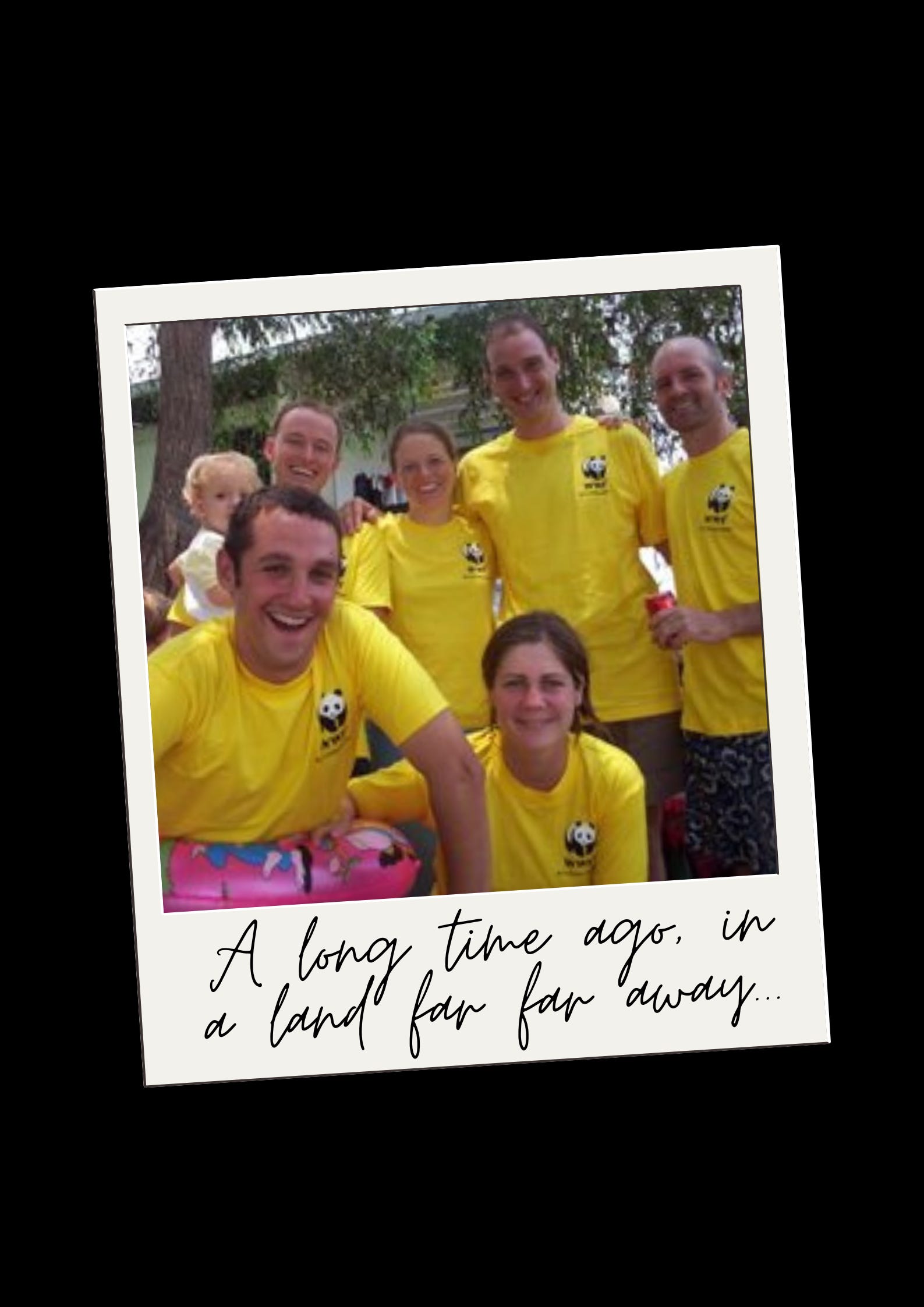
So, there I am – standing on the banks of the Mekong River with a hundred or so charity swimmers.
And I’m the only one wearing a pink rubber ring.
I had taken an innocent question from a work colleague (“you up for a charity swim this weekend?”) to mean something altogether different (“you up for some frivolity in fancy dress?”).
The sight of so many serious-faced expats in speedos and swim caps suggested I might have got the wrong end of this particular stick.
As soon as the swim began, things quickly went downhill. I quickly realised that a child-sized inflatable ring squeezed round my waist and the harsh currents of the Mekong didn’t pair at all well.
By halfway, I was the salmon who had run out of swim. I waved for the safety boat to save my life (if not my blushes) and take me to the finish line, where ninety-nine fellow swimmers looked on with a mixture of disdain and bemusement.
Embarrassing? Perhaps. Memorable? Undoubtedly.
That giant sucking sound
In today’s landscape, pink rubber rings are definitely not in fashion.
In fact, we find ourselves being funnelled down a path where individuality and difference are actively discouraged. We are like children being steered away from what looks interesting, towards what our parents think is ‘best’.
We see it in the blueprints, the frameworks, the shortcuts we are fed every day. We see it in the relentless push to “enhance” and “optimise”. We see it in in the sale of the mythical silver bullet – the one way that will work like no other way has worked before.
We’re being sucked into a whirlpool of ‘slick-but-same’.
It isn’t just the rise of AI ‘trendslop’ flooding our inbox and social media feeds. It isn’t just the irksome use of ChatGPT-isms across all forms of communication.
It’s the very nature of the AI tools that we use every day.
A study earlier this year by Harvard Business Review brought this into sharp focus. Researchers found that leading AI tools, when asked for strategic advice, consistently gravitated toward the same narrow set of answers – regardless of context.
To quote the authors:
”LLMs consistently recommend strategies that align with modern managerial buzzwords and trends rather than context-specific strategic logic.”
AI may be the world’s biggest bazaar – but we are all being sold the same carpet.
And that’s hardly surprising when you think about it. AI is a convergence machine, after all. It is trained to find the acceptable answer, which means gravitating towards received wisdom, popular choices, the middle ground.
But as humans, we tend to be wary of The Right Answer. We know that just because something works over there, doesn’t mean it will produce the same result over here. Over time, we learn to hold open more than one line of enquiry, to entertain multiple possibilities.
The very thing a convergence machine is designed to resist.
So, if you’re wondering what’s the giant sucking sound is, it’s the sound of us all being funnelled together – becoming ever smarter, and ever more alike.
The consequences of convergence
This isn’t just a philosophical problem about the effect of AI on humanity . The emergence of ‘slick-but-same’ is fast becoming a commercial problem for anyone trying to sell expertise.
Because, in the end, whatever shape your expertise takes – you are first and foremost selling something abstract: an idea, a picture, a vision.
For that idea – that brand – to land with the right people, it must be meaningfully different from the other available options. It must find a way to capture attention, and to hold that attention up to the point the buyer says “let’s do this”.
Thing is…‘slick-but-same’ is the #1 attention killer.
Worried about losing ground to the competition, we’ve turned to AI to make ourselves/our offering/our content slicker and smarter. And, on the whole, it works. The median is undoubtedly better than it used to be.
But we forget that perceptions of quality (or anything, for that matter) depend on context. We judge something not in the abstract, but in light of known alternatives.
And that’s where things are going wrong.
We are building websites, reports, marketing campaigns – the picture of who we are and what we can offer – to look competent, thoughtful, and trustworthy.
Just like AI told us to. And just like everyone else.
But here’s the problem…
When everyone looks competent, no one is.
When everyone looks thoughtful, no one is.
When everyone looks trustworthy, no one is.
The reality is we can’t all win by using the same playbook. We can’t all look the same, and expect to stand out.
It’s time we pushed back against the tides of convergence.
A considered resistance
At this point, I need to hold my hand up and say: “I’m not a natural contrarian.” I genuinely admire the rebels, the pirates; those who challenge conventions and rewrite the rules. But I’m usually ready to join long after the ship has set sail.
And yet every week I speak to brilliant, thoughtful people who are being sucked in – either unknowingly or simply because they fear swimming against the tide. And I’ve realised this is no time to be backward about coming forward.
So, here’s my contribution to the considered resistance – a few guiding principles I’m trying to live by right now:
Be more journalist
Be less librarian (looking for answers, putting everything in its right place) and be more journalist. Ask interesting people interesting questions. Peel back the layers behind their answers until you get to something deeper – a revelation, some beauty, the truth. This is where true insight comes from, and not just the answers everyone is being fed by the AI engines.
Find your corner
The world probably doesn’t need another generalist expert who knows a little about a lot of different things. Find your corner – that area of expertise where you/your team/your business goes deep – and own it. The world will thank you for it.
Protect what you value
Whatever you hand over to AI will inevitably atrophy over time. That’s why I do my initial thinking (and personal writing) offline before taking it to Claude. Whether it’s thinking, writing, designing, or research – if you don’t want it to go weak and wither, don’t ask AI to do it for you.
These are strange times we find ourselves in. As the German poet Georg Büchner put it: “We are all living in cages with the door open.”
Here’s to swimming against the tide, to resisting the gravitational pull towards being slick-but-same.
And if you need a visual metaphor for a ‘Summer of resistance’, you’re welcome to borrow my pink rubber ring – any time.
Dave Vann
P.S. Here are a few fellow resisters I’m following right now:
Alex H Smith, Blair Enns, Alex Barker
This is so well-put. I love how you put where you stand as a contrarian (why am I an institutionalist even now?) and your recommendation of being a journalist. A journalist, rather than librarian, approach to our social relationships....I see that mentality solving a LOT of tech-shaped isolation.